
Moving the light source—this is the idea behind Jaume Ramírez's new design. Milana is a system of modular pendant lamps that can be combined and moved both vertically and horizontally.
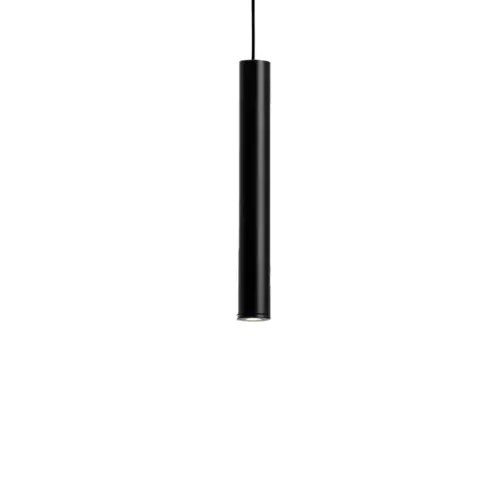
Paradoxically, this new design begins with the deconstruction of the lamp archetype: by simplifying it to its bare essentials, it is left with only a suspended cylindrical body with an integrated LED.
This cylinder can be fitted with various conical shades in pearl white, black, beige, gray, and red, and in several sizes. But the most ingenious feature is that each of these lamps can be fitted with a simple counterweight, allowing it to be moved when hung between two points. The tubular structure and shade are made of lacquered aluminum with a translucent polycarbonate diffuser. A rope with a counterweight allows the lamp to be moved around the space.
-
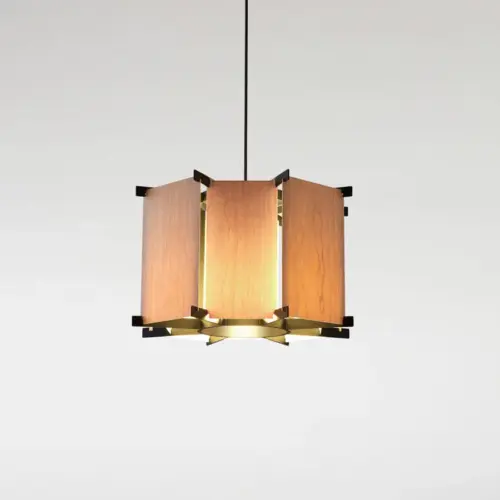
The name MVV comes from the initials of his name, a way of reclaiming his authorship. This was the wish of his grandson—also an architect—and the collaborators at his studio, Two-bo. Pablo, María, and Alberto have revived this lamp 45 years later. Marset acts as a hinge in time, taking the original design—an octagon with overlapping slats—and updating it by giving it a double skin: cherry wood on the outside of the slats, and white on the inside to optimize the quality of the light. The original dimensions – 45 cm – are respected, and the internal structure, originally made of iron, is now also made of polycarbonate to make it lighter. Using wood as a material, the MVV achieves exceptionally warm lighting. A steel and glossy black polycarbonate structure supports eight PET panels with a cherry wood exterior and a white interior. A transparent methacrylate diffuser sits atop the panel.
-
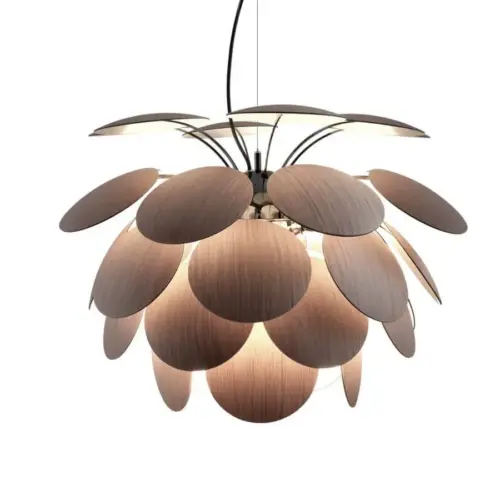
The original dimensions – 45 cm – are respected, and the internal structure, originally made of iron, is now also made of polycarbonate to make it lighter. Using wood as a material, the MVV achieves exceptionally warm lighting. A steel and glossy black polycarbonate structure supports eight PET panels with a cherry wood exterior and a white interior. A transparent methacrylate diffuser sits atop the panel. 35 injected ABS discs. Chrome dial.
Finishes: White (RAL 9003), Matte Gray (RAL 7037), Matte Beige (RAL 1001), Black-Gold (RAL 9004-Gold). Available in 5 sizes (diameters of 35, 53, 68, 88, and 132 cm). Also available in a pressed oak finish, only in a 68 cm diameter, with a black chrome dial. -
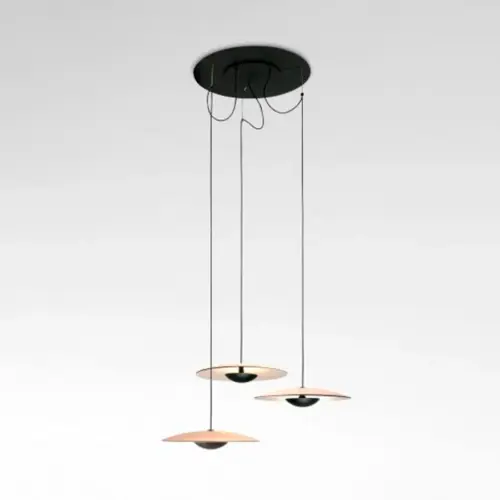
The Ginger collection has expanded over time to meet diverse lighting needs, offering various versions including pendant, table, wall, and floor lamps, as well as movable arm versions. A new, smaller pendant size, a portable table lamp, a wall lamp with a movable arm, and three sizes of elegantly simple wall lights that can be combined have been added. 4mm pressed wood diffuser in natural oak or wenge. Die-cast aluminum heat sink and matte black lacquer finish.
-
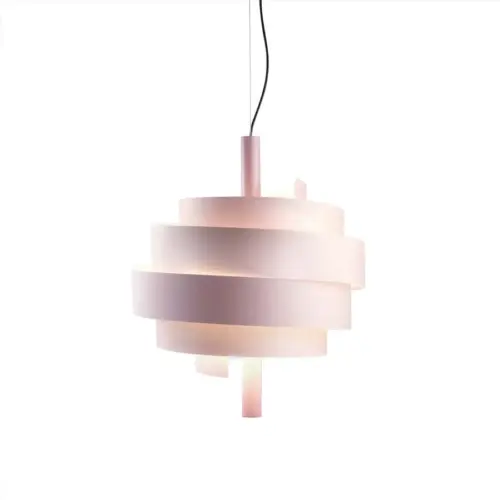
The Piola collection seeks to mimic this fluidity of infinite movement, floating around the light, in search of a balance between light diffusion and shadow creation. The spiral shape of the shade breaks the object's monotony, changing with each viewing angle. The central tube conveys symmetry and solidity, contrasting with the volatile and variable shade. Available in four colors, both the structure and the shade are always the same color, so the lamp is perceived as a single object. In this way, by contrast, the light takes center stage. PVC and polyester laminated tape that rotates around a central metal tube lacquered in the same color as the tape. Internal polycarbonate structure that supports the tape.
-
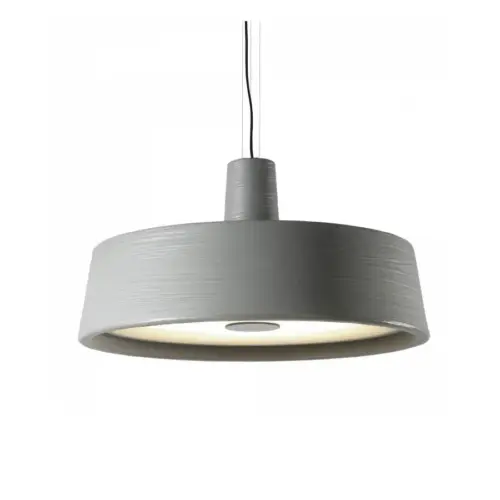
Soho is presented as a statement. It's a tribute to the merits of this lamp, traditionally used in markets, taverns, and cafes. After reflecting on volumes, proportions, and materials, new uses and lighting effects have emerged. The use of rotomolded polyethylene allows for the production of different sizes. While the Soho collection previously offered diameters of 57 cm and 112 cm for large spaces, it is now also available with a smaller, 38 cm shade for more versatile use, as this scale is better suited to smaller spaces. Rotomolded polyethylene shade. Opal methacrylate diffuser. Black lacquered metal frame with cataphoresis anti-corrosion treatment for outdoor use. Available in White, Stone Gray, Black, Sand (Soho 38 version only) and Sky Blue (Soho 38 version only) Available in 3 sizes (112.6cm, 57cm and 38cm)
-
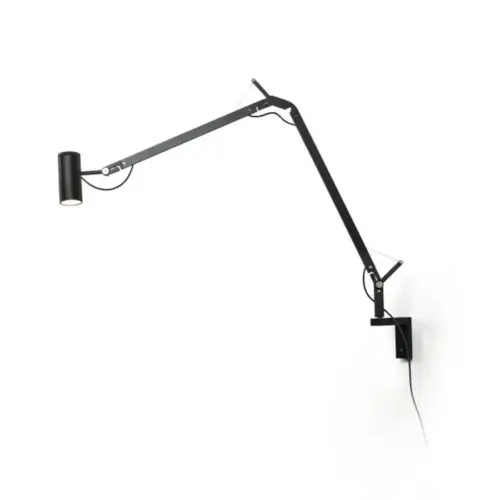
The fluidity of its movements and its perfect stability make this flexible lamp a light source that can be moved around the table without taking up much space. This articulated lamp incorporates LED technology, allowing you to direct the light beam with precision. Lacquered aluminum structure and diffuser. Switch integrated into the diffuser. Metal base with polycarbonate cap. Available in black and white, and with a range of accessories: base, clamp, table stand, wall mount, and floor stand.
-
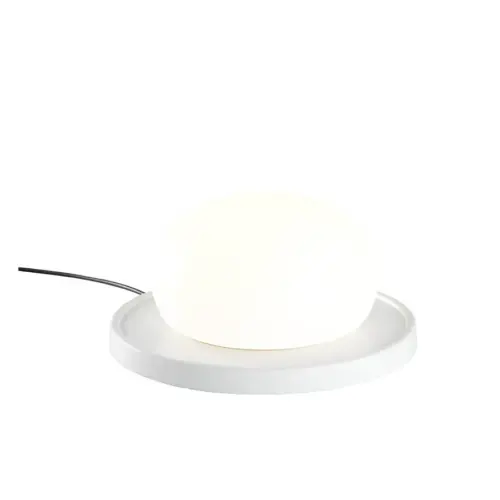
Its structure is as simple as it is magical: a round surface housing an LED located at its center and a superimposed glass ball that, when moved, constantly produces the effect of an eclipse. By moving the ball, we dim or brighten the light, and this game captivates with its beautiful visual effect. Bolita aims to encourage user interaction. Florian and Sebastian from the kaschkasch studio conceived the idea of a lamp where dimming was done mechanically, not electronically. This technologically innovative design celebrates the sense of touch. Lacquered steel base housing the light source. A slightly magnetized, opal-blown glass diffuser rests on top of the base and moves across the surface. Switch located on the side of the base.
-
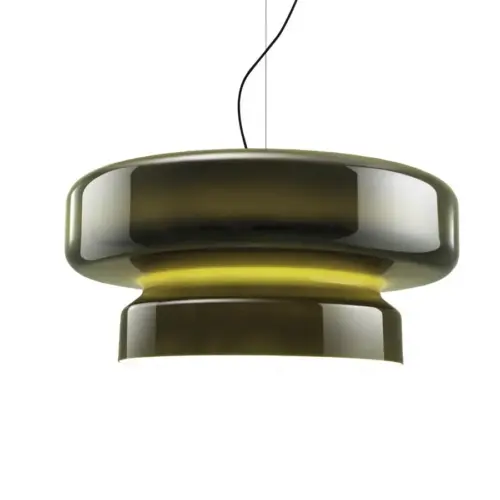
The Bohemia is a unique lamp. Joan Gaspar designed a large, highly efficient pendant lamp that closely resembles glass. A difficult challenge that the designer overcomes by using polycarbonate as the material. This lamp boasts an organic, anything but boring, translucent profile that integrates two volumes into a single form. The result is a large shade available in various colors that don't clash with the interior—always white—providing impeccable lighting, free from chromatic contamination. When lit, it casts white light downwards while simultaneously emitting nuances and shadows on the screen that enrich its form. The Bohemia is bright, striking, with exceptional light, and aims to surprise the viewer. Translucent, two-layer, rotomolded polycarbonate screen, always with a white interior. Opal methacrylate diffuser in the LED version.
-
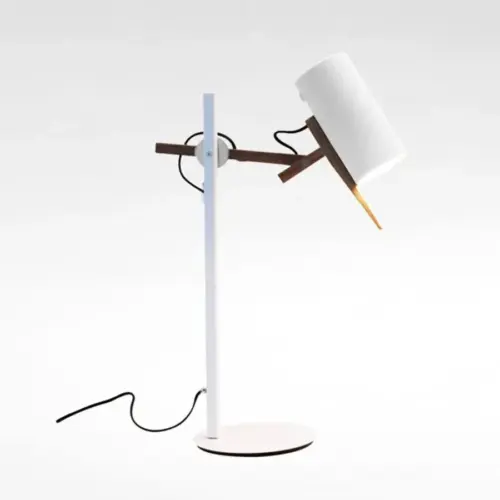
The assembly of basic geometric shapes and the use of wood alongside metal give this family of luminaires an approachable feel while also possessing a distinctive personality. All movements of the shade, including full rotation, are achieved through joints and arms, and their technical precision means that no visible springs or counterweights are required to maintain the chosen position. La palabra inglesa Scantling hace referencia a las dimensiones de la sección de una varilla de madera, y deriva de una herramienta de medida utilizada antiguamente. La evidencia de su juego constructivo procura a esta lámpara una cierta imagen arquetípica, casi gráfica.Tija y base de hierro lacado. Brazo de roble macizo que sostiene un difusor de aluminio. El interruptor está incorporado en la pantalla.
-
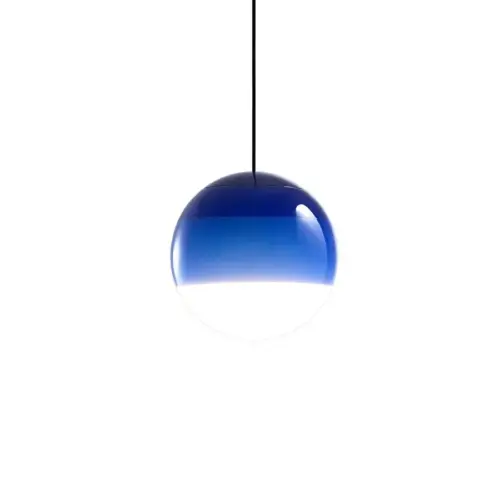
The story of the Dipping Light has only just begun. Marset wasn't content with just the two table lamp sizes it has offered until now: its most poetic lamp is expanding its uses and is now available as a portable, standalone lamp, a pendant lamp, a wall lamp, and in a new table lamp size – ø20 cm – somewhere between small and large. The colors remain the same, but the range of styles has been expanded. The new Dipping Light pendant light is stripped down to its essentials, making color the absolute star. That's why creating a composition with several of them results in a captivating visual effect. This new model is available in three different sizes: 12.5, 20, and 30 centimeters in diameter. Bright white blown glass shade with multiple layers of paint. A polycarbonate trim on top completes the spherical shape.
-
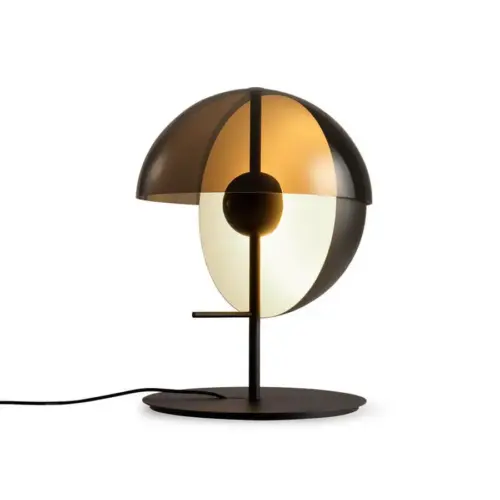
The name of the Greek goddess Theia—mother of the sun, moon, and dawn—is given to this lamp because its design primarily aims to express the beauty of light and the fascination we feel for it. Theia has two faces; to discover them, simply rotate it gently on its axis. It can be directed towards the user and function as a reading lamp. Or, it can be directed towards an object or a wall, creating a subtle, indirect light effect that instantly warms the room. This rotation completely changes the perception of the piece, as its metal diffuser is entirely opaque. Base and stem made of lacquered iron. Lacquered aluminum heat sink with integrated switch. Vertical hemisphere made of lacquered cast iron, with a white interior, and a transparent, smoked, thermoformed methacrylate shade.