

If your home sits within reach of the sea, your terrace faces a harder brief than most. Strong sun, salt air, pool chlorine and humidity work on materials at the same time. Choosing outdoor furniture for a coastal climate on the Costa del Sol is partly about the material and partly about the care each home can realistically give.
This guide sets out what the weather does, how the main materials respond, and how to match them to a year-round residence, a holiday home or a rental. It draws on the care advice of the makers we carry.
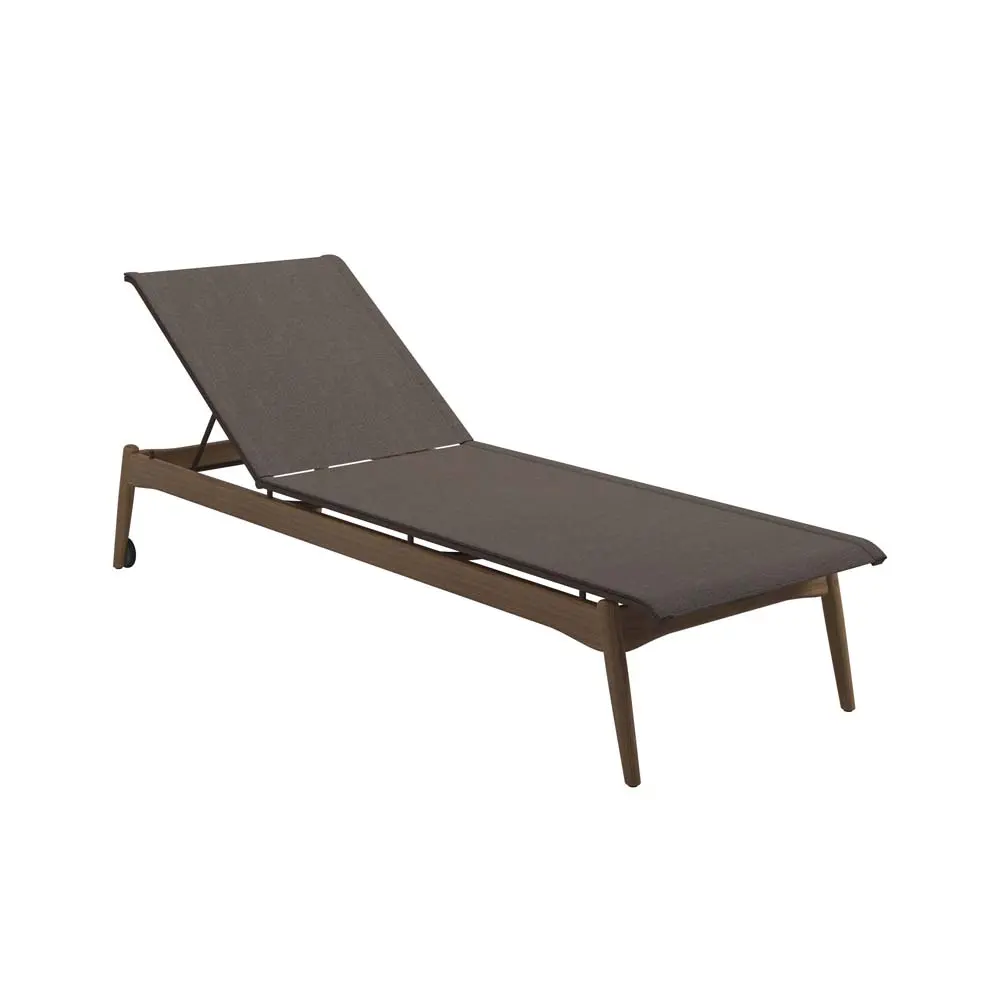
What the coastal climate does to outdoor furniture
Four things act on a seaside terrace, often together. Strong sun fades some finishes and dries out timber. Salt air leaves airborne chlorides on every surface, and these are the main cause of corrosion on metal near the coast. Pool chlorine adds more chlorides, especially on furniture set close to the water. Humidity keeps everything damp, which is what mould needs to take hold on fabrics and, in the wrong conditions, on wood.
The practical answer to the search for the best outdoor furniture for salt air is not a single material. It is a material whose upkeep suits how often someone is there to give it. A residence lived in all year can follow a routine that a rental cannot. Our outdoor furniture selection spans several of these materials.
Teak outdoor furniture care: patina, sealer or oil, and what not to do
Left in sun and rain, teak turns to a silver grey. Tribù, Gloster and Kettal all describe this in their care guides as an aesthetic change that does not affect the strength of the wood. Gloster’s teak comes from managed plantations and is a close-grained hardwood with a high natural oil content, which makes it resistant to rot.
If you prefer to keep the honey tone, a sealer is used and reapplied. Kettal recommends applying it roughly every three months, more often in hospitality settings; Tribù suggests once a season. Two cautions matter. Tribù advises against oil, which can cause flaking, mould or staining, and Gloster notes that teak is not painted or varnished. Gloster also warns against ever using a pressure washer, as it erodes the surface, and suggests cleaning once or twice a year. It is best not to move a teak piece straight from the garden into a heated room. You will find teak among the Gloster and Tribù ranges in our catalogue.
Powder-coated aluminium: cleaning near the coast
Powder-coated aluminium is light and does not rust, but the coating still needs looking after by the sea. Kettal and DEDON both advise cleaning with lukewarm water, a pH-neutral detergent and a soft cloth, with no abrasives, solvents or pressure washers, and cleaning more often in coastal areas.
One rule is easy to overlook. Kettal advises against cleaning the paint when the surface is above 25°C, so work in the shade or early in the day. Regular upkeep helps prevent corrosion, colour change and loss of gloss, which matters most on the coast. Kettal’s Terrain paints, designed by Doshi Levien, are an electrostatically applied polyester powder cured at 160°C to protect the aluminium against extreme weather. See the Kettal range for these finishes.
Marine grade stainless steel outdoor furniture: 304 or 316
Not all stainless steel is the same near salt water. According to Australia’s stainless steel association (ASSDA), grade 316 contains between 2 and 3% molybdenum, which improves resistance to pitting corrosion in chloride environments. It is the grade chosen for buildings facing the sea and is known as marine grade. Grade 304 has no molybdenum and is the standard stainless steel.
Wherever it sits near the coast or a pool, DEDON advises cleaning stainless steel often because of chlorides, avoiding chlorine-based products such as bleach, and keeping it away from contact with iron or rust, which can mark the surface.
Synthetic fibres and ropes
Woven synthetic fibres suit the coast well. DEDON states that its fibre resists UV, salt water, chlorine and extreme temperatures without cracking or losing colour, and does not absorb moisture. It is cleaned with a cloth, lukewarm water and mild soap, without alcohol or solvents, and tolerates a low-pressure wash. That combination is a sensible starting point for many seaside terraces; see the DEDON range.
Rope details need their own routine. For Kettal ropes such as Bela Rope, in polypropylene, brush or vacuum off dust, then clean with mild soap and water and rinse. Treat stains by dabbing rather than rubbing.
Cushions and fabrics: solution-dyed, bleach and storage
Solution-dyed acrylics such as Sunbrella are very well suited to the coast, as the colour runs through the whole fibre and the cloth resists mould. Bleach advice varies by maker, so the fabric label is the rule. Sunbrella allows a mild bleach solution for mould; DEDON prohibits bleach on its acrylic because it discolours.
Cushions need care whatever the cover. DEDON does not recommend leaving them out permanently, advises drying them after rain and storing them fully dry over winter, and warns that protective covers should not sit on cushions all the time, as condensation causes mould. Gervasoni offers over 50 water-repellent, mould-resistant outdoor fabrics, and both DEDON’s BRIXX and Gervasoni’s iroko InOut 709 use quick-drying or water-repellent foams.
Holiday home or rental: choosing when nobody is there daily
If the house is empty for weeks, choose for low upkeep. Teak kept in its honey tone needs a sealer several times a year, so an unattended terrace is a poor match unless you accept the silver grey, which is purely cosmetic. Powder-coated aluminium and synthetic fibre ask for less frequent attention, though salt still calls for a rinse when someone visits. Marine grade 316 stainless steel is the right choice for seafront metal, but DEDON advises cleaning it often because of chlorides, so it suits homes where someone can keep to that.
Cushions are the weak point. Where nobody can bring them in after rain, plan storage, quick-drying foams and easy access to a dry cupboard. Gervasoni’s outdoor programme, built around materials treated to stay outside all year, is worth looking at through our Gervasoni range.
See and choose it with us in Marbella or Málaga
Oboe is a family-run design furniture business founded in 1987, and our outdoor catalogue includes Kettal, DEDON, Gervasoni, Tribù, Gloster and Vondom, among others. The clearest way to compare a teak table with an aluminium or fibre piece is to see them and talk through the care each one needs for your terrace.
You can book an appointment at our two-floor Marbella showroom near Puerto Banús or at our Málaga showrooms, ask our team for advice, or request a quote on any piece. Our whole team speaks English, and our interior design service can plan a full terrace.
Frequently asked questions
What is the best outdoor furniture for salt air?
There is no single answer. Powder-coated aluminium and synthetic fibres such as DEDON’s cope well with salt air and ask for less frequent care. Marine grade 316 stainless steel suits the seafront but needs cleaning often because of chlorides. Teak needs a sealer several times a year if you want to keep its honey tone rather than the silver grey.
What is the difference between 304 and 316 stainless steel?
Grade 316 contains between 2 and 3% molybdenum, which resists pitting corrosion in chloride environments better, so it is chosen for seafront settings and called marine grade. Grade 304 has no molybdenum and is the standard stainless steel. Near the coast or a pool, 316 is the safer choice.
Should I oil my teak outdoor furniture?
Tribù advises against oil, which can cause flaking, mould or staining, and Gloster notes teak is not painted or varnished. To keep the honey tone, a sealer is used and reapplied, roughly every three months for Kettal and once a season for Tribù. Otherwise teak weathers to a harmless silver grey.
Can I use a pressure washer on outdoor furniture?
It depends on the material. Gloster warns against ever using a pressure washer on teak because it erodes the surface. Kettal and DEDON advise against pressure washing powder-coated aluminium. DEDON’s synthetic fibre does tolerate a low-pressure wash. When unsure, use lukewarm water, mild soap and a soft cloth.
Do I need to store outdoor cushions in winter?
DEDON does not recommend leaving cushions outside permanently. Dry them after rain and store them fully dry over winter, and avoid leaving protective covers on all the time, as trapped condensation causes mould. Solution-dyed acrylics resist mould, but follow the fabric label for any bleach advice.